Old burner in Skawina reminds of the furnace replacement

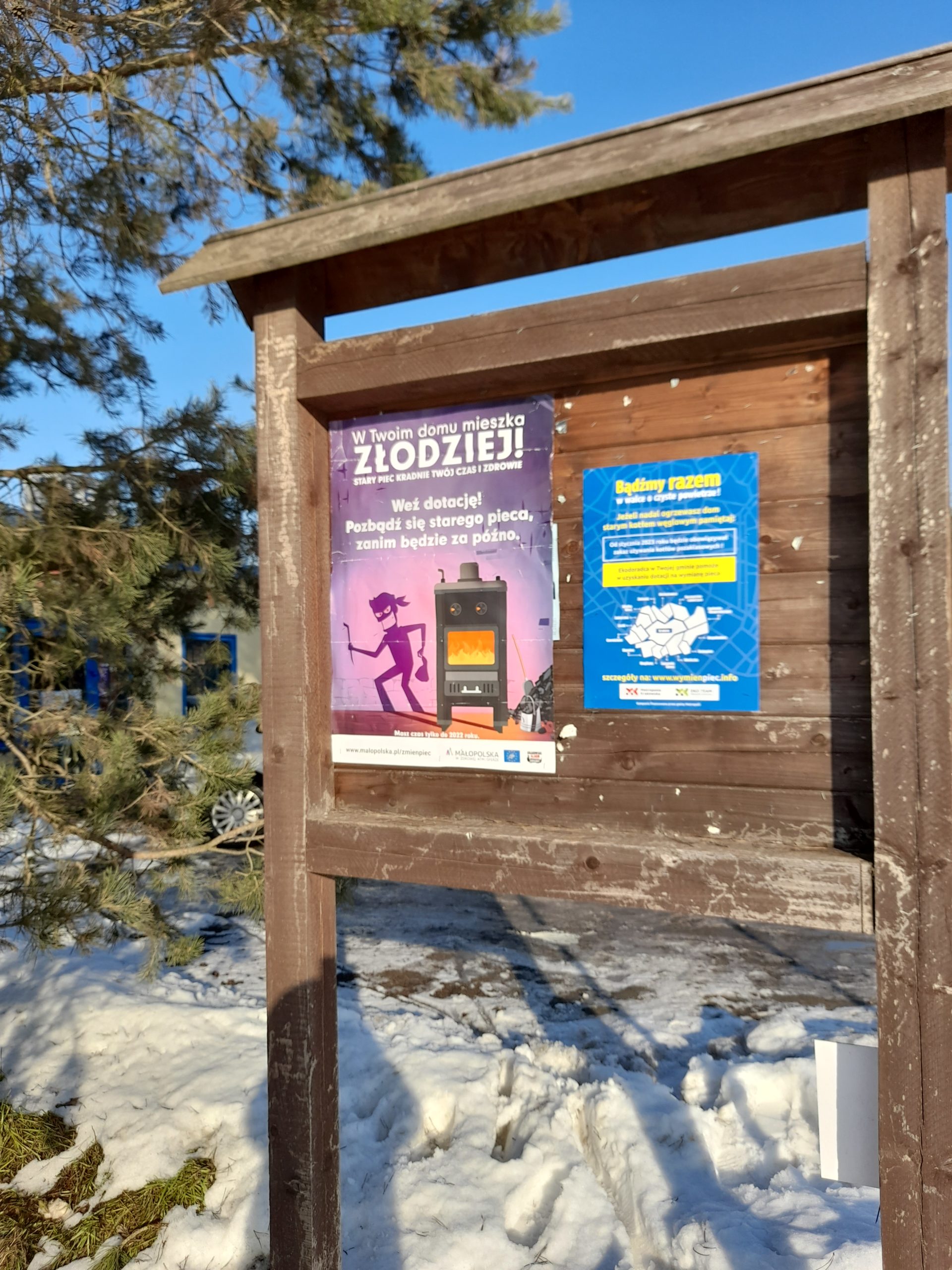
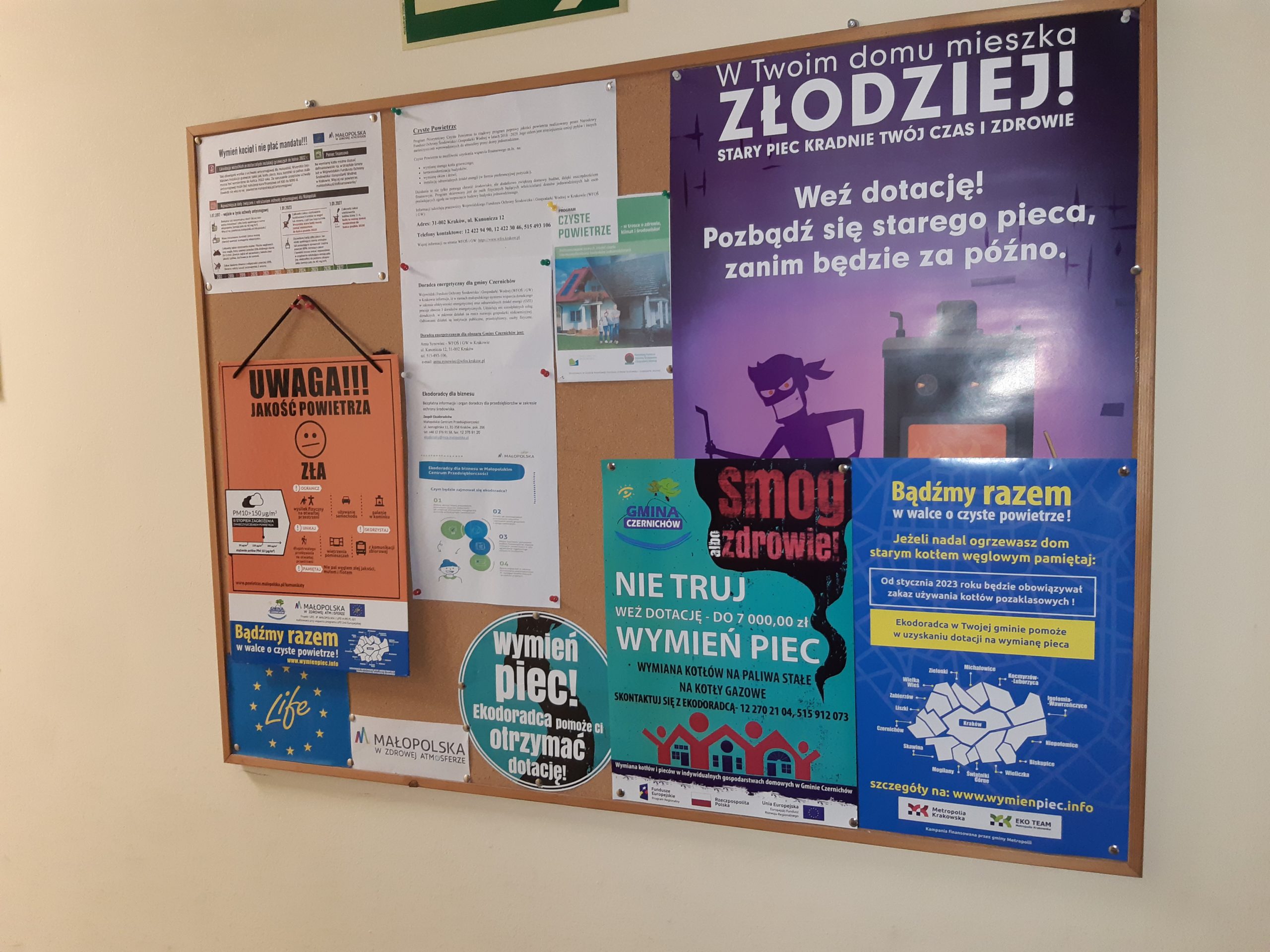
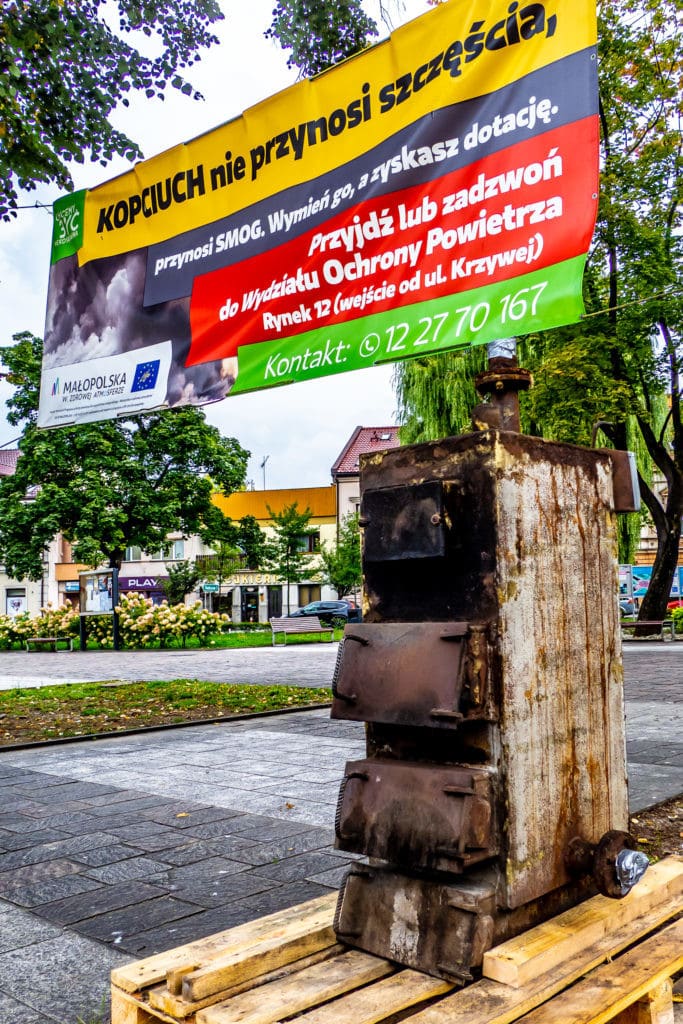
At the last moment before the heating season begins, a monument to an old coal stove, the so called “kopciuch”, appeared in the market square in Skawiń. It will remain there until the end of winter, and its task is to remind residents of the obligation to replace old, inefficient heating devices by the end of 2022, in accordance with the provisions of the anti-smog resolution for Małopolska.

Autumn is fast approaching and with it comes the subject of heating our homes and, consequently, the subject of smog. Officials in Skawina are now launching an unusual promotional campaign in their municipality, in which they are encouraging residents to replace old, unfriendly heating appliances. The “stove” monument, placed in the middle of the Skawina market square, is to remind the inhabitants about the deadline for replacing the boilers that do not meet any emission standards. It is worth considering replacing the equipment now and take advantage of the high subsidies from the Clean Air Programme.
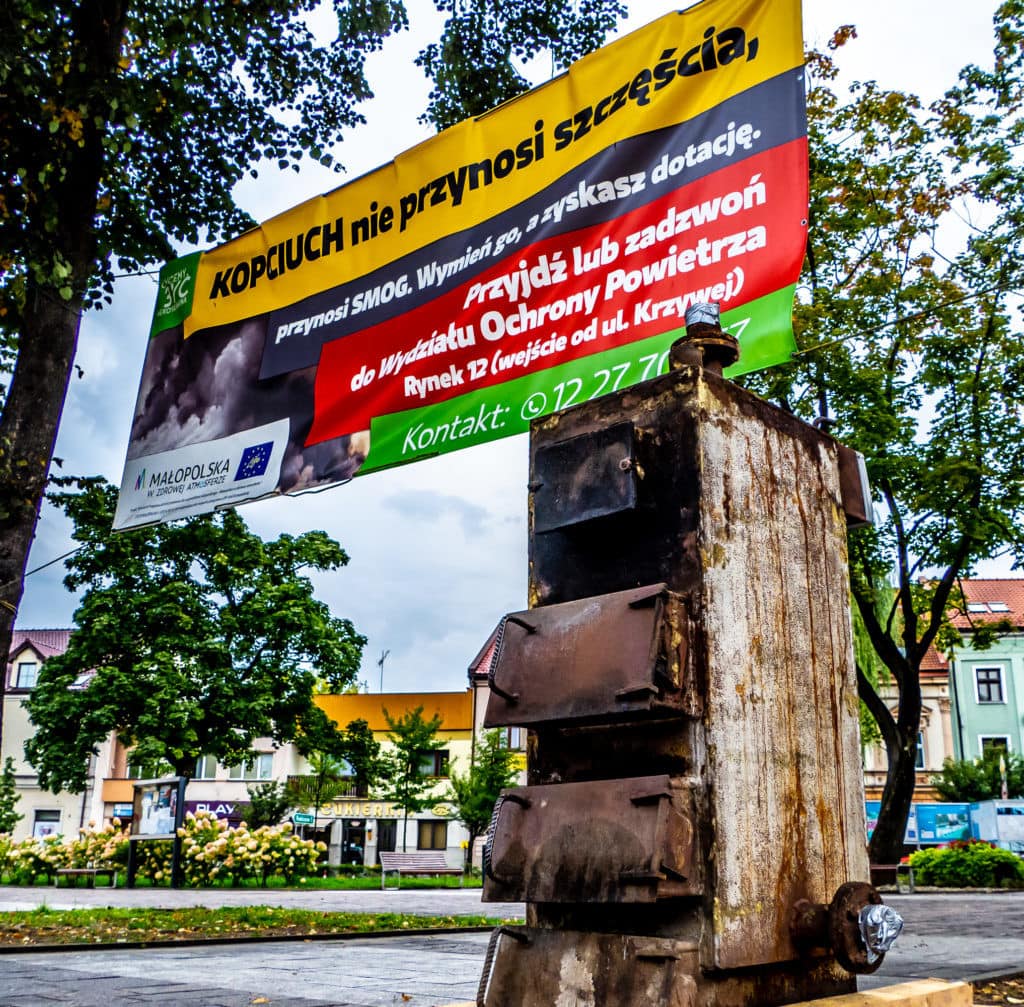
An unconventional idea

In the fight for clean air, unconventional methods often prove to be the most effective in informing residents. The main intention of placing the “kopciuch” is to focus the inhabitants’ attention on the subject of inefficient heating of buildings and to encourage them to liquidate this type of equipment. – The idea was born out of necessity. – says Norbert Rzepisko, the mayor of Skawina town and commune. – In spite of many information campaigns on the Internet, at village meetings, in schools and during inspections of household boiler houses, there are still residents who may not know about the obligation to replace the “old stove” by the end of 2022. Old, worn out furnace on the marketplace attracts attention and may encourage to remove it. – adds the mayor.

The location of the monument was chosen not accidentally. The market square in Skawina is one of the most frequented places in the commune. The aim of the action is to reach as many residents as possible, including the younger ones. -It will be used to educate young people. Children from schools and kindergartens will take part in classes conducted by an eco-managers who will show them an old stove, explain how harmful it is to use it and tell them what to do to reduce air pollution in Skawina in the future’, explain the officials.

Take a grant to replace your old furnace and insulate your home

Under the anti-smog resolution, all non-class equipment that does not meet any emission standards must be removed from the Małopolska province by the end of 2022, so there is really little time left. However, residents are not left alone with this obligation. There is an information point of the “Clean Air” Programme in almost every commune in Małopolska. This program provides up to 37 thousand PLN of subsidies, thanks to which the residents may replace their old furnace and carry out thermal modernization of the building. In each of those points we can count on specialized advice of an eco-managers or consultant and we will get help in filling in the grant application. – In order to facilitate obtaining of such a large subsidy an eco-manager needed, who will become a “translator” of subsidy intricacies. He will help to fill in all the documentation in such a way so that the inhabitants could get as much support as possible”, informs the officials in Skawiń.

In the Municipality of Skawina the consultation and social point of the “Clean Air” Programme is located in the Air Protection Department of the Municipal Office in Skawina, Rynek 12 (entrance from Krzywa Street). The point is open from Monday to Friday during the office working hours, i.e:

Monday from 8:00 a.m. to 5:00 p.m.

Tuesday – Thursday 7:30 a.m. – 3:30 p.m.

Friday, 7:30 a.m. to 2:30 p.m.

Eco-managers can also be contacted by phone or email:

Eco-managerContact phoneE-mail address
Aneta Błaszczyk
(EKO-TEAM)
12 2770 167
lub
882 353 455
[email protected]
Piotr Drzyżdżyk
(EKO-TEAM)
12 2770 014
lub
532 458 080
[email protected]
Ewelina Podkopacz
(EKO-TEAM)
12 2770 167
lub
532 085 350
[email protected]
Krzysztof Szulada
(Projekt LIFE)
12 2770 168
lub
789 204 751
[email protected]

Remember to submit your declaration to CEEB

From July 1st the submission of declarations to the Central Register of Building Emissions has started. Its purpose is to collect data on heat sources and fuel combustion in residential and non-residential buildings throughout Poland. Filing of the declaration is obligatory. You can do it yourself, without leaving your home. All you need is a trusted profile, an electronic signature or an e-card. In order to fill in the declaration one has to go to the website www.zone.gunb.gov.pl and choose the option “File declaration”. The last step is just to fill it in and send. If you have any questions it is worth contacting an Eco-manager in your municipality or reading the website of the Central Office of Construction Supervision where you can find the most common questions with answers. You can also submit the declaration in a traditional (paper) form to the municipal office. Remember that you can help improve air quality in your area by submitting the CEEB declaration by the end of this year.
On 5 July the call for applications under the new NFOŚiGW program “Climatic Spas. Part 2) Supporting energy efficiency in public utility buildings in health resort communities”. The call will be held on a continuous basis until 29 March 2024 or until the allocation of funds (PLN 200 million) is exhausted.

Program Objective:

Improve air quality and reduce greenhouse gas emissions in the spa or spa protection area through optimized investments in improving energy efficiency and increasing energy production from renewable sources.

Subject of Continuous Recruitment:

Select projects that improve air quality by reducing energy consumption in buildings for funding.

Type of projects:

Types of projects eligible for funding:

Investments involving support for energy efficiency in buildings of public utility and collective residence – located directly in the spa or spa protection area, in particular:

  1. Energy modernization of the above buildings, on the basis of an energy audit, showing a minimum reduction of 30% of the building’s final energy demand (the recommended degree of reduction meeting the definition of deep thermomodernization is 60%);
  2. modernization/replacement/installation of a heat source and/or hot water for the above buildings, on the basis of an energy audit, with the reservation that the above buildings, for which the implementation of the above improvement is planned as a separate activity – with regard to insulation of the envelope: external walls, window woodwork and roof/ceiling – meet the requirements of at least WT2014. No co-financing is allowed for the change of the heat source to a heat source fired by fossil solid fuels;
  3. installation of PV systems and/or replacement of lighting with energy-efficient lighting for the aforementioned buildings – on the basis of a proper electricity audit, with the proviso that the electricity production from PV systems is balanced for the purposes of: optimizing the electricity consumption of the building’s built-in and/or external lighting and operating the technical and installation systems in the building.

The prerequisite for receiving support in terms of project readiness for implementation is the possession of energy audits and final environmental decisions.

Beneficiaries:

  1. local government units with the status of a health resort or health resort protection area (within the meaning of the Act of July 28, 2005 on health resort treatment, health resorts and health resort protection areas and on health resort communes (Dz. U. 2020, item 1662, as amended))
  2. Commercial law companies in which local government units referred to in item. 1) hold 100% of shares or stocks, which are established to perform own tasks of local government units specified in the Acts.

Forms of Funding:

Grant

The intensity of the grant depends on the standard of improvements implemented, as specified in Section 7.5 of the program, and is up to:

  • 70% of the eligible costs of the project, subject to the provisions of subsection b,
  • 40% of the eligible costs of the project in case the project concerns only the realization of the improvement mentioned in point 3) Project type.

Intake Budget:

The call budget for the program objective is up to PLN 200,000 thousand.

Deadlines and how to apply:

Applications must be submitted between 15/07/2021 and 29/03/2024 or until the allocation of funds is exhausted.

Applications will be considered in order of receipt until the call budget is exhausted, applications exceeding the call budget will be left without consideration.

More information can be found here

On July 1, 2021, the Central Emission Evidence of Buildings (CEEB) was launched – the result of the work of the Central Office of Building Control with the cooperation of regional and local authorities and other institutions involved in improving air quality from across Poland.

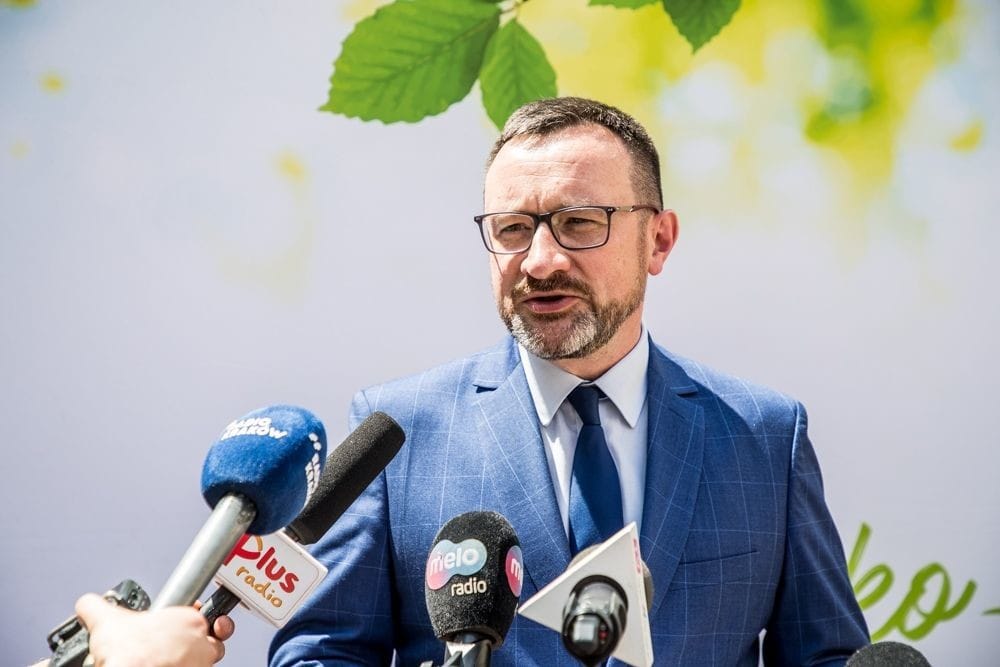
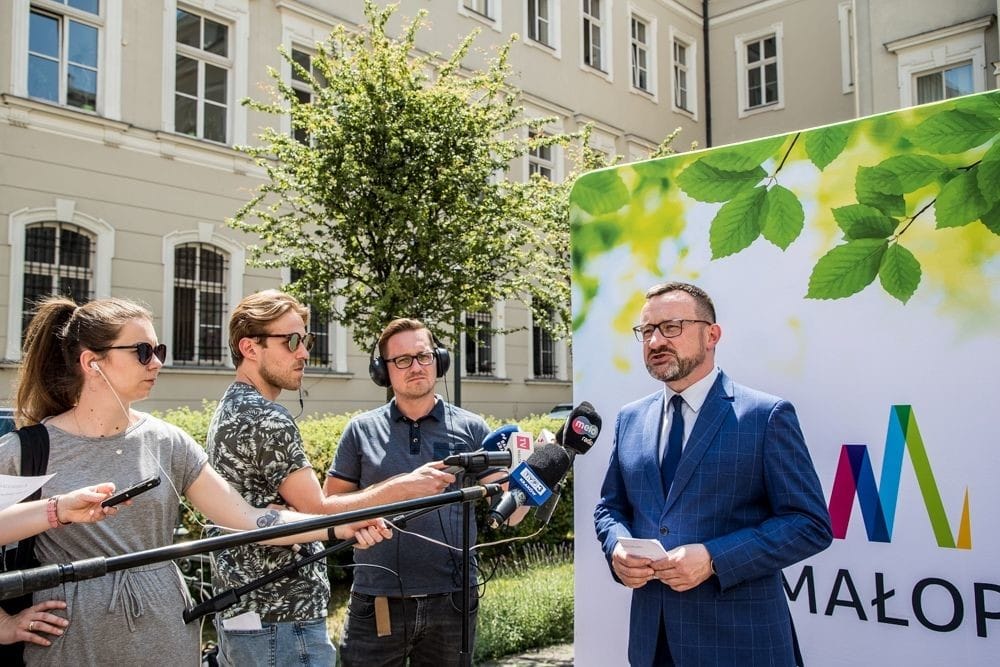
I am extremely pleased that the experience gained by Małopolska in recent years in conducting inventories on a regional scale has been reflected in the creation of a national inventory database.

says Deputy Speaker Tomasz Urynowicz.

What is CEEB?

It is an IT tool used to collect and make available information on the heating of all buildings across the country. The first functionalities made available make it possible for residents to submit their declaration electronically via the zone.gunb.gov.pl portal or in paper form via their municipality. The data collected relates to the heat sources owned and used and its scope has been adjusted so that each resident and building manager is able to provide reliable information in an easy way.

Who should file the return?

Information on used and owned heating devices should be provided by each owner of a residential or non-residential building. In the case of multi-family buildings, this obligation should be fulfilled by the manager collectively for part or the entire building.

By when do we have time?

Each building owner or manager is required to submit an electronic or paper declaration within 12 months of the base being operational, which is from July 1, 2021 to June 30, 2022 for existing heating equipment.

In the case of newly created heating devices, the deadline is 14 days from the start of the heat source.

CEEB and regional regulations

According to the provisions of the Air Protection Program for the Malopolska Region, municipalities are obliged to conduct an inventory on their territory, and thanks to the launching of CEEB, this task can be carried out in the national system. Each commune should make an inventory of 70% of buildings by the end of 2021 and 90% by 30 June 2022

I encourage all residents of Malopolska to make a declaration in the CEEB system by the end of this year. This will be an expression of responsibility and care for air quality in our region.
Tomasz Urynowicz, Deputy Speaker, appeals.

More information?

The ability to download or submit declarations and information related to the launch of CEEB can be found at zone.gunb.gov.co.uk.

Answers to frequently asked questions can be found at the link here

On June 28th this year, in the session hall of the Marshal’s Office a meeting with the representatives of Rumia authorities took place.

Course of the meeting

At the meeting, the Deputy Director of the Environment Department presented the activities of the Marshal’s Office aimed at improving air quality. During the meeting there were discussed topics concerning among others: the process of introduction of anti-smog resolution for Kraków and Małopolska, applying for the participation in the international project LIFE and the activities of the Marshal’s Office and communes in connection with the new Air Protection Program.

The Mayor of Rumia and his co-workers were happy to ask questions concerning, among others, the effectiveness of boiler replacement after the introduction of anti-smog resolutions, the principles of implementing a LIFE-type project, as well as the possibilities of financing and accounting for the project. At the end of the meeting, the Mayor assured about further cooperation and contact with Rumia.

Exchange of experience

Exchange of experience in the field of air protection is extremely important not only on the international, but also on the national level. The Małopolskie Voivodeship is a pioneer in air protection by taking certain actions, including, among others, the first anti-smog resolution for the Małopolskie Voivodeship in Poland, which initiated the adoption of similar legal acts in 14 other voivodeships, and participation in the integrated LIFE project, which is the first such project in Poland.

Skawina, Niepołomice, Krzeszowice, the cities of Nowy Targ and Oświęcim – these are the local governments of Lesser Poland, which want to introduce a complete ban on burning coal as of 1 January 2030. Public consultations on local anti-smog resolutions are just beginning in their areas. Communes which decide on a local anti-smog law will receive preferences in access to funds from the Regional Operational Programme for the years 2021-2027.

This is a milestone in the fight for clean air in Małopolska. We can clearly see that this topic is increasingly important, and that attitudes towards environmental issues are changing. The discussion on local anti-smog resolutions is the beginning of a revolution

emphasizes Deputy Speaker Tomasz Urynowicz.

Local anti-smog resolutions are ahead of provincial regulations. According to the anti-smog resolution for Małopolska, non-classified stoves, the so-called “kopciuchy”, must be replaced by the end of 2022. However it will still be possible to use coal in modern heating devices. More and more local governments of Malopolska decide to take bolder steps. This is encouraged by the significant improvement of air quality in Cracow, where as of September 2019 there is a total ban on using solid fuels. Apart from Skawina, Niepołomice, Krzeszowice, Nowy Targ and Oświęcim, the local governments of Tarnów, Rabka-Zdrój and communes of Zabierzów, Czarny Dunajec are also discussing a local ban on coal.

Local anti-smog resolutions will be adopted by the Sejmik of the Małopolskie Voivodeship at the request of the communes and after the commune council adopts an appropriate directional resolution, worked out during the consultation process. The greatest benefit of adopting local resolutions will be the health of residents – faster achievement of air quality consistent with Polish and European standards. An additional benefit is the preferential treatment of such municipalities when allocating funds from the Regional Operational Programme for 2021-2027.

However, in order to introduce restrictions, local authorities must also provide their inhabitants with assistance in replacing stoves. First of all, the activity of eco-managers, functioning of the service point of the Clean Air grant programme and support for people suffering from so-called energy poverty.

These activities are part of the national energy policy, and active local governments receive all possible substantive assistance from the Board of the Małopolska Voivodeship

added Deputy Speaker Tomasz Urynowicz.

The content of draft local anti-smog resolutions can be read at: tu

On the same website, you can also submit your opinion on the draft resolutions by taking part in the public consultation until July 14, 2021.

Polish Smog Alarm and the European Clean Air Centre cordially invite you to the webinar “Rozmowy o Czystym Powietrzu: Jak szybko pokonać niską emisji” (Clean Air Talks: How to quickly beat low emissions), which will be held on June 22 from 14.00 to 16.30.

We’re going to talk about that:

  • how to accelerate the pace of implementation of anti-smog resolutions and replacement of old boilers for coal and wood;
  • how to improve the implementation of the Clean Air Program;
  • what are the proposals for activities to eliminate low emissions within the regional operational programs (European Regional Development Fund);
  • whether Clean Air and financial incentives are enough to overcome low emissions;
  • and how to enforce anti-smog resolutions.

Among the speakers and panelists confirmed their participation are: Bartłomiej Orzeł, Prime Minister’s Plenipotentiary for Clean Air; Tomasz Urynowicz, Vice-Marshal of Małopolska Region; Paweł Mirowski, Deputy President of the National Fund for Environmental Protection and Water Management; Piotr Kuczera, President of Rybnik; Bogusław Król, Head of Zielonki Commune; Marcin Podgórski, Director of the Department of Waste Management, Emissions and Integrated Permits, Office of the Marshal of the Mazowieckie Voivodeship; Blanka Romanowska, Director of the Department of Infrastructure and Environment, Upper Silesia and Zagłębie Metropolis; Paweł Ścigalski, Plenipotentiary of the Mayor of Kraków for Clean Air; Andrzej Mirowski, Deputy President of the National Fund for Environmental Protection; Piotr Kuczera, Mayor of Rybnik Andrzej Urbanik, Directorate General for Regional Policy, European Commission.

How to participate in the webinar?

The event is free to attend but requires registration. Registration link:https://live.evenea.com/487-049-820.There will be an opportunity to ask questions of the speakers and panelists during the meeting.

Meeting Agenda:

  • 14:00 – 14:15 – Introduction to the discussion, Andrzej Guła, leader of the Polish Smog Alarm, European Clean Air Centre.
  • 14:15 – 16:15 – Discussion with invited guests and participants online and via chat. Discussion will be moderated by Dominika Wantuch, Gazeta Wyborcza journalist specializing in air protection issues. Co moderator Andrzej Guła.

The discussion was divided into two parts:

Part I 14:15 – 15:00 Panel.

The panel will include:

  • Bartłomiej Orzeł, Prime Minister’s Plenipotentiary for Clean Air,
  • Tomasz Urynowicz, Vice-Marshal of Małopolska Region,
  • Paweł Mirowski, Deputy President of the National Fund for Environmental Protection and Water Management,
  • Piotr Kuczera, President of Rybnik.

Part II 15:00 – 15:30. Online discussions

The online discussion will include:

  1. Andrzej Urbanik, Directorate General for Regional Policy, European Commission;
  2. Marcin Podgórski, Director of the Department of Waste Management, Emissions and Integrated Permits in the Office of the Marshal of the Mazowieckie Voivodeship;
  3. Bogusław Król, Head of the Zielonki Commune,
  4. Blanka Romanowska, Director of the Department of Infrastructure and Environment, Upper Silesian and Zagłębie Metropolis;
  5. Paweł Ścigalski, Plenipotentiary of the Mayor of Kraków for Clean Air.

Part III. Questions and answers of the panelists 15:30 – 16:15

  • 16:15 – 16:30 – Closing

In recent weeks, the councils of Małopolska’s municipalities have been engaged in a heated discussion on the adoption of local anti-smog resolutions. Let us remind that the anti-smog resolution for Małopolska is already in force in the entire voivodship. Its main goal is to replace out-of-class solid fuel boilers by the end of 2022. Local resolutions are to some extent aimed at tightening these regulations, mainly by eliminating the possibility of installing coal-fired boilers.

Such resolutions will be adopted by the Sejmik of the Małopolskie Voivodeship at the request of communes and after the Commune Council adopts an appropriate directional resolution. The first municipalities to adopt such resolutions were the City of Oświęcim, City of Nowy Targ, Skawina, and Krzeszowice. Now it is up to the Board of Małopolska Voivodeship to pass resolutions for public consultation.

According to the provisions of the new Air Protection Programme for the Małopolskie Voivodeship, at the request of the interested communes, it is possible to adopt local anti-smog resolutions according to uniform guidelines. The purpose of those regulations is to accelerate the process of air quality improvement, implementation of climate policy goals as well as new Polish Energy Policy until 2040. The air protection programme also indicates the need for these municipalities to be covered by preferential investment co-financing under the Regional Operational Programme 2021-2027.

Key considerations for local anti-smog resolutions:

  • Ban operation for new coal-fired boilers and heaters beginning January 1, 2022 and existing boilers and heaters beginning January 1, 2030.
  • Stricter requirements for new biomass boilers (dust emissions up to 20 mg/m³) and new fireplaces (closed combustion chamber, automatic control) as of January 1, 2023.
  • Compliance with other deadlines and requirements of the current anti-smog resolution for Małopolska, including replacement of out-of-class boilers by the end of 2022 and class 3 and 4 boilers by the end of 2026.

The Supreme Administrative Court has rejected the cassation appeal filed by coal sellers in the case of the anti-smog resolution for Małopolska. The verdict of the highest instance means that the anti-smog regulations for Małopolska may no longer be invalidated.

This is excellent news. We had no doubt that Małopolska’s anti-smog legislation, which by the way has become a model for the rest of the country, is lawful and in the public interest. The ruling of the highest instance only confirms our conviction

comments Tomasz Urynowicz, Deputy Marshal of Małopolska.

Earlier, complaints against the anti-smog resolution for Małopolska were dismissed by the Regional Administrative Court in Kraków. Opponents of the resolution then applied to the Supreme Administrative Court for cassation of the verdict, but the court rejected the application, closing the possibility of further appeals.

The anti-smog resolution for Małopolska has been in force since July 2017 and marks the next stages of the fight for clean air. At first, it introduced a ban on installing outdated coal stoves, as well as a ban on burning poor-quality coal, fines, sludge and so-called flotsam. The next milestones include replacement of “kopciuchów” (i.e. stoves that do not meet the requirements of at least class 3 of the so-called ecodesign) by the end of 2022 and class 3 and 4 boilers by the end of 2026. The implementation of the resolution, including obtaining by residents subsidies and reliefs for replacement of furnaces, is assisted by the Air Protection Programme for Małopolska adopted in 2020.

A separate anti-smog resolution, completely banning coal and wood burning, has been in force since September 2019 in Krakow. The improvement of air in the capital of Małopolska is clearly noticeable and confirmed by the research of experts, among others, of the AGH University of Science and Technology and the European Clean Air Centre.

This is why other local governments in Małopolska want to follow Krakow’s example by preparing their own local anti-smog resolutions. These are, among others, the communes of: Czarny Dunajec, Nowy Targ, Rabka-Zdrój, Chrzanów, Skawina, Zabierzów, Krzeszowice, Niepołomice, as well as the city of Oświęcim and the city of Tarnów.

The Eurepean City Facility is an initiative that supports local authorities in developing investment concepts that contribute to the implementation of the measures defined in their local climate and energy action plans (SEAPs, SECAPs and others). Its overarching objective is to mobilise sustainable energy investments in European cities and municipalities.

On 6 May at 10:00 a.m., a webinar will be held on Call II, which runs until 31 May.

Registration for the webinar is held at the following link:

https://zoom.us/meeting/register/tJ0sd-Cvrz0pEtIxSAsRZdUwjliAT2S1egD-

Both those who are already preparing their application are invited, as during the event they will learn how they can justify the investment presented in the application, as well as those who are just thinking about which investment concept within the EUCF grant could receive funding, to get familiar with the application process and the necessary documents needed during the application.

The current applicable documents are available on the official EUCF website under “Application process”.

The event will also include a Q&A session where an EUCF national expert will answer your questions.

The webinar will take place via the Zoom Meeting platform. Once you have registered via the link and your registration has been accepted by the organiser, you will receive an email with confirmation of your registration and a link to the meeting.

On Friday, 9 April, a meeting was held of representatives of the municipal authorities of Skawina, Zabierzów, Krzeszowice, Rabka-Zdrój and the cities of Tarnów and Oświęcim with Tomasz Urynowicz, Deputy Marshall. The meeting was devoted to the development of principles for adopting local anti-smog resolutions. Municipalities which decide on a local anti-smog law will gain preferences in access to funds from the Regional Operational Programme for the years 2021-2027.

  Discussions with representatives of municipalities which care about concrete measures for the health of their inhabitants have been fruitful. The most important objective of the local anti-smog resolutions will be the ban on using coal from the beginning of the year 2030. I would like to emphasise that these actions are in line with the national energy policy, and active self-governments receive all possible substantive assistance from the Board of the Małopolskie Region. Procedures worked out together will result in defect-free documents and their legislative path. I hope that other municipalities in Małopolska will use them

– said Deputy Marshal of Małopolska Tomasz Urynowicz.

The main task of local anti-smog resolutions is the complete elimination of coal-fired heating devices by 1 January 2030, and leaving in use only those biomass furnaces that meet at least the so-called ecodesign requirements. Such resolutions will be adopted by the Lesser Poland Regional Assembly at the request of municipalities and after the Municipal Council adopts an appropriate directional resolution. The biggest benefit of adopting local resolutions will be the health of residents – faster achievement of air quality consistent with Polish and European standards. An additional benefit is the preferential treatment of such municipalities when allocating funds from the Regional Operational Programme for the years 2021-2027.

However, in order to introduce restrictions, local authorities must also provide residents with assistance in replacing furnaces: first and foremost, the activity of ecomanagers, the operation of a service point for the Clean Air grant programme, and shelter programmes for people suffering from energy poverty.

Local anti-smog resolutions, apart from a complete elimination of coal heating devices, ensure consistency with the provincial resolution , which assumes that:

  • by 31 December 2022, all boilers fired by solid fuels which do not comply with any emission standards, i.e. the requirements of at least class 3 according to PN-EN 303-5:2012, must be replaced
  • by 31 December 2026, solid fuel boilers must be replaced which comply with the requirements of class 3 or 4 in accordance with PN-EN 303-5:2012
  • furnaces which comply with the requirements of class 5 in accordance with the PN-EN 303-5:2012 standard and which were in operation before 1 July 2017 may be used until the end of their service life.

Only radical steps will improve air quality, and it should be noted that smog causes a similar number of deaths annually in Poland as the Covid-19 virus – over 45,000

– summarised Deputy Speaker Tomasz Urynowicz.

Good news for local authorities! On 31 March 2021, the second part of the “Stop Smog” programme started, implemented by municipalities where anti-smog resolutions applied. This year’s edition of the programme, which allows for assistance to people affected by energy poverty, contains important simplifications.

The most important changes include the possibility for inter-municipal associations and districts to apply to the programme as coordinators and the admission of co-financing for installations in buildings owned by municipalities. The period from the conclusion of the agreement to the realisation of the investment has also been extended from 3 to 4 years.

    I believe that these changes will make a real contribution to faster replacement of furnaces in Małopolska, because they concern the group which is most difficult to make progress with – those affected by energy poverty. However, for this to become possible, a lot of activity on the part of local authorities is needed, which I am very much counting on

– Deputy Marshal Tomasz Urynowicz commented on the changes in the Stop Smog programme.

The “Stop Smog” programme is scheduled to run from 2019 to 2024. Applicants (municipality, inter-municipal association, district) can obtain up to 70 per cent funding of the investment costs, the remaining 30 per cent being their own contribution. As a result, selected residents of municipalities also from Małopolska can receive a non-refundable grant for 100 per cent of the cost of replacing the furnace. In the first call for applications to the “Stop Smog” programme, applications were signed by the municipalities: Niepołomice, Skawina, Sucha Beskidzka and Tuchów.

The average cost of the investment in one building (in the case of a building with two units – in one unit) cannot exceed 53 thousand zloty.

According to the anti-smog resolution for Małopolska, by the end of 2022 all out-of-class furnaces must be replaced, and by the end of 2026 those of emission class 3 or 4.

More information about the new Stop Smog programme: www.nfosigw.gov.pl

The European City Facility is an initiative that supports local governments in developing investment concepts that contribute to the realisation of the actions defined in their local climate and energy action plans (SEAP, SECAP and others). Its primary goal is to mobilise sustainable energy investments in European cities and municipals.

With the EUCF programme there is a possibility to apply for financial support of 60,000 Euros and expert assistance during the development of the selected concept. This cover activities such as feasibility studies, market analyses, stakeholder analyses, legal, economic and financial analyses, risk analyses, coordination and organizational activities.

Key objectives of the EUCF initiative:

  • providing cities with practical technical and financial knowledge, inspired by best european practices, in order to stimulate public and private investments,
  • Building competencies of officials in developing new projects and providing them with tools and opportunities for creating contacts network and knowledge transfer,
  • easing access, especially for small and medium-sized communities, to private financing and EU funding, like: European Structural and Investment Fund (EFSI), Horizon 2020 and European Investment Bank (EIB) services.
  • Effective use of EUCF beneficiaries’ knowledge to reach more than 10,000 cities and communities and encourage further action in European cities.

The application process is simple and transparent and consists of two steps: verification of qualifications and submission of the full application form.

First Call

From 25 May to 2 October 2020, the first call for the EUCF ran, during which more than 250 applications were submitted from all over Europe! Only 11 applications from Central and Eastern European countries received financial support of 60 thousand Euros for the development of investment concepts. As the only 2 municipalities from Poland as a result of the 1st call were awarded: Sztum and Piaseczno. Sztum will prepare an Investment Concept for a package of measures that will ultimately achieve energy self-sufficiency of the community. Analyses will be prepared concerning the construction of new renowable energy sources and energy storage facilities as well as the segment of water supply, sewage and wastewater treatment. In 12 months, a Concept will be ready, which will enable obtaining funds to begin implementation of these investments. For Piaseczno, the EUCF grant is also the beginning of a very ambitious complex programme of energy transformation, reduction of CO2 emissions and improvement of air quality. The Investment Concept, which will be prepared from the grant, will include a plan for construction of an ecological electro-heating plant and extension of the district heating network with connection of new consumers.

Second Call

The second call for proposals will run from March 29th to May 31st, during which over twice as many applicants will receive grants of 60,000 Euros as during the first edition. The list of qualified territorial units has also been extended (including counties, metropolitan areas and associations of communities). The EUCF team encourages cities across the European Union to identify their sustainable energy projects and to contact their national expert, who is available to applicants.

Important information!

The template documents required for the second call may differ slightly from those required in 2020. Currently valid documents are available on the official EUCF website under “Application process”.

Official website: https://www.eucityfacility.eu/home.html

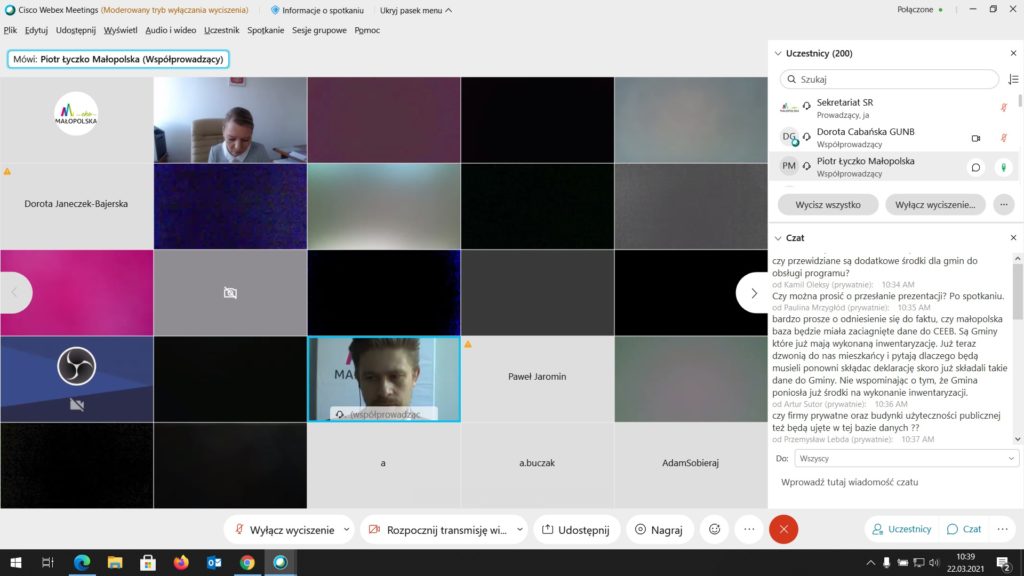
On 22 March 2021 a meeting organized together with the General Office of Building Control was held via the Cisco Webex Meetings online platform. It was an opportunity to get informed about the current state of works on the Central Emission Efficiency Record for Buildings (CEEB) system and to obtain answers to questions. The conference was attended by over 200 participants.

What did we learn?

During the conference the General Office of Building Control presented and discussed several topics:

1. The purpose of creating CEEB,

2. The advanced status of work on system reliability,

3. the final draft of the future central register,

4. the Authority in the process of making the declaration to CEEB and deadlines for submission of declarations.

During the discussion part, the participants were willing to ask questions concerning the principles of the system operation and to present their doubts. The topics discussed included the introduction of heat produced by using renewable energy sources, lack of submissions of declarations by citizens, real estates with unregulated legal status and planned nationwide educational campaigns.

Benefits for communities and their citizens

The planned implementation of the system, which is CEEB, will be very beneficial for the communities and citizens. The system will make it possible to collect data on the energy status of buildings, information on forms of public support (subsidies, preferential loans) granted for thermomodernization or replacement of boilers in buildings. All shared activities in this area will bring us closer to improving air quality.

Tomasz Urynowicz, Deputy Marshall of the Małopolska Region, has again asked the Minister for Climate and Environment to tighten quality standards for coal and to draw up such standards for pellets. The introduction of these regulations is possible under the obligatory review of quality requirements for solid fuels pursuant to Article 3a of the Act on the system of monitoring and controlling the quality of fuels.

Coal and biomass boilers available on the market are only able to meet ecodesign requirements if coal, pellets and wood of adequate quality are used. However, the quality requirements for commercially available coal differ from the parameters of this fuel used at the laboratory testing stage. Therefore it calls for the introduction of quality standards for coal meeting these minimum requirements set out in PN-EN 303-5:2012.

– explains Deputy Marshal Tomasz Urynowicz.

Unfortunately, there are also still no legal regulations on the quality requirements for pellets. It is therefore impossible to eliminate poor quality pellets from sale, which contain a large amount of mineral substances (e.g. ash) and even plastics. Pellet boiler users are not aware that the fuel they use often has little to do with the fight for clean air.

– says the Deputy Marshal.

Air quality plans and anti-smog resolutions in force in individual provinces assume that the use of heating devices compliant with the ecodesign standards will contribute to a significant improvement in air quality. Achievement of emission indicators at the eco-design level will, however, be possible only in the situation of using appropriate quality fuel. Therefore, failure to introduce standards for coal and pellets at an appropriate level may negate the real effects of boiler replacement under the Clean Air Program and other support instruments.

The Central Office of Building Control is currently in the process of launching the Central Emission Efficiency Record for Buildings (CEEB). This is a key tool to identify all heating sources that require adjustment to the requirements of the anti-smog resolution.

We warmly invite you to participate in a meeting organised jointly with the General Office of Construction Supervision, which will provide an opportunity to learn about the current status of work on CEEB. The on-line meeting will take place on 22 March 2021, from 10.00 – 13.00.

Topics to be presented at the meeting:

  1. The purpose of creating CEEB
  2. Status of the work on the creation of the CEEB Declaration
  3. Presentation and discussion on the draft declaration
  4. The role of the Authority in the process of making the declaration to CEEB
  5. Deadlines for submission of declarations.

To register, please complete the form available at www.powietrze.malopolska.pl/konferencja-CEEB. A link to the meeting will be automatically sent to your email address after registration.

What is CEEB?

The Central Emission Inventory for Buildings (CEEB) is an IT mechanism for identifying sources of low emissions from buildings. The system will collect key information on emission sources in the municipal and household sector.

The project assumes that the system will make it possible to collect data on the energy condition of buildings, information on forms of public aid (subsidies, preferential loans) granted for thermal modernisation or replacement of boilers in buildings.

Main events

  • All the municipalities of Małopolska submitted a declaration of cooperation with the Provincial Fund for Environmental Protection and Water Management in Krakow regarding the operation of service points for the Clean Air program.
  • The Voivodship Administrative Court rejected the complaints of the municipalities of Rzepiennik Strzyżewski and Oświęcim against the “Air Quality Plan” adopted by the Sejmik of the Małopolska Region.
  • On 25 February a meeting was held in Krakow between Bartłomiej Orzeł, Tomasz Urynowicz and councillors from the Małopolska Region on better use of funds from the largest Polish subsidy programme for the replacement of furnaces.
  • Due to the hacking attack on the UMWM IT systems and the COVID-19 pandemic, the implementation of the Competence Center and eco-managers activities under the LIFE project was limited. Performing full-time tasks was difficult due to remote work and limitations in accepting clients and organizing events.
  • Eco-managers distributed in total almost 80 thousand information and educational materials and gave over 9 thousand pieces of advice to Małopolska residents.

C.1. Eco-managers

Advice and help for residents

In February, Eco-managers employed under the LIFE Program provided advisory assistance to the inhabitants of Małopolska in the amount of:

  • 2887 persons admitted in the office
  • 5132 by telephone
  • 663 in writing or by e-mail
  • 351 during visits

942 inspections were carried out at residents regarding waste incineration. In 33 cases, violations were found.

Questionnaires from residents and applications for funding

Eco-managers were involved in collecting surveys from residents and processing applications for funding.

In February 2021:

  • 339 questionnaires were collected from residents interested in benefiting from the funding,
  • 230 applications of residents or entities for co-financing were examined,
  • 291 agreements with residents or entities for co-financing were signed and 7 such agreements were settled.

The eco-managers entered or updated data on 323 buildings in the heating database.

C.2. Competence Centre

List of low-emission heating appliances

The list of low-emission solid fuel heating appliances that meet ecodesign requirements, available at www.powietrze.malopolska.pl, includes a total of 355 boilers and space heaters.

Eco-intervention” application

1315 applications were received in February. The application is available at https://ekomalopolska.pl/app/ekointerwencja/index.html.

It can be specified:

  • 1134 reports on air pollution,
  • 145 illegal waste disposal,
  • 36 other reports.

The hotline operated by the Competence Centre of UMWM responded to over 350 phone calls.

Online training – Meeting the expert

The National Energy Conservation Agency, within the framework of the online training entitled “Meeting with an expert”, organised in February four events with the participation of eco-managers:

  • 03.02. – Meeting with KAPE expert – electromobility,
  • 10.02. – Meeting with KAPE expert – energy saving requirements and thermal insulation of buildings after 31 December 2020,
  • 17.02. – Meeting with KAPE expert -ELENA technical assistance in preparing investments in energy efficiency and renewable energy,
  • 24.02. – Meeting with KAPE expert – obligatory audits for entrepreneurs.

More municipalities to introduce local anti-smog resolutions!

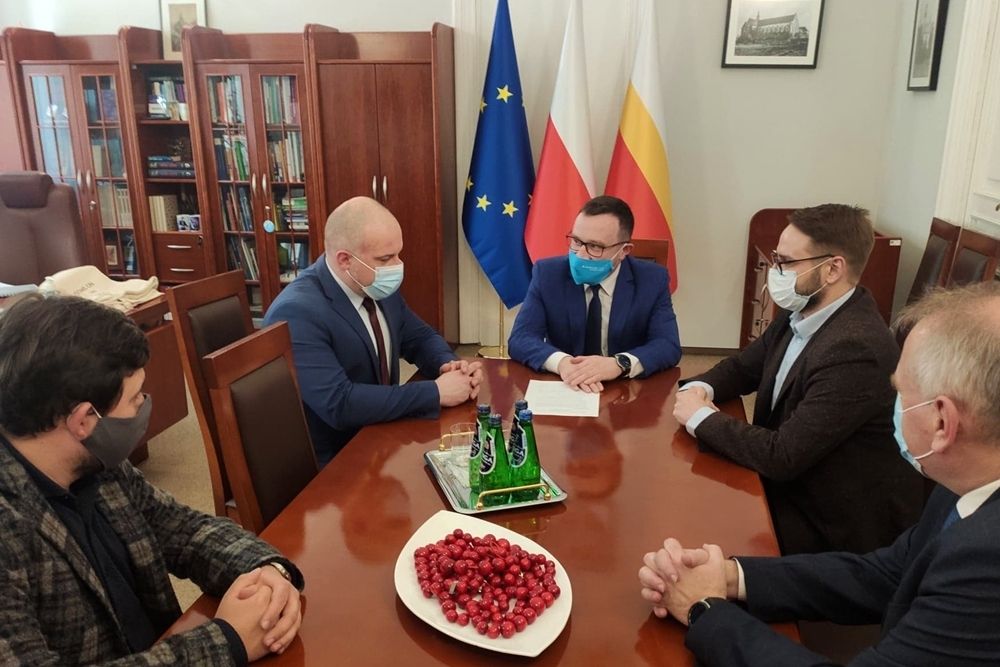
Skawina, Tarnów, Oświęcim and Rabka-Zdrój, as well as Krzeszowice are the next Małopolska communes which intend to introduce local anti-smog resolutions. These are restrictions on the use of solid fuels, especially coal. Representatives of self-governments of the mentioned communes discussed the proposed provisions on Monday, 1 February this year during a remote meeting attended also by Tomasz Urynowicz, Deputy Marshal of Małopolska, and Piotr Łyczko, Deputy Director of the Department of Environment, Office of the Marshal.

D1. Monitoring of effects of implementation of Air Quality Plan for Małopolska Region (MPOP)

The Voivodship Administrative Court rejected the complaints of the communes of Rzepiennik Strzyżewski and Oświęcim against the “Air Quality Plan” adopted by the Sejmik of the Małopolska Region.

E.2. Local information and education activities on air protection

Educational materials on air protection

Eco-managers in communes:

  • prepared 54 926 leaflets and brochures and 1900 posters,
  • distributed 67 697 leaflets and brochures as well as 2035 posters,
  • prepared 10 540 and distributed 11 740 other educational and promotional materials (promotional materials, leaflets related to the Clean Air Program).

Meetings and events

Eco-managers organised meetings and events:

  • 1 competition for children/young people, in which 16 people participated,
  • 1 meeting in school, attended by 10 people,
  • 5 meetings with citizens, attended by 158 people,
  • 38 meetings with local leaders, with a total of 93 people.
  • 8 other air protection events attended by 176 people.

E. 3. creating networks for exchanging experience with other projects.

Grupa Azoty S.A. and the Małopolska Region signed an agreement on cooperation for air and climate protection

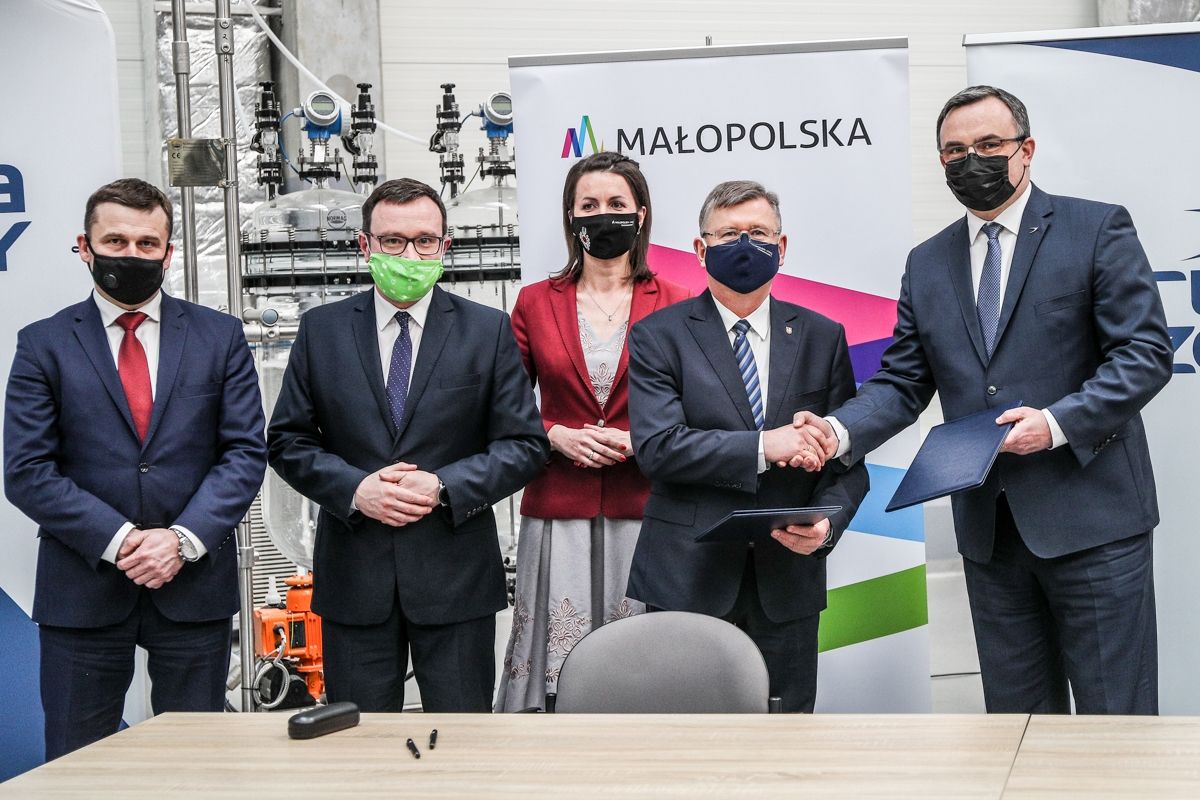
Grupa Azoty S.A. and the Małopolska Region signed an agreement on cooperation for air and climate protection within the LIFE EKOMAŁOPOLSKA project – “Implementation of the Regional Action Plan for Climate and Energy” during a meeting at the Research and Development Centre of Grupa Azoty in Tarnów.

Meeting on the “Clean Air” program

On February 25, in Krakow, Bartłomiej Orzel, the government plenipotentiary for the Clean Air program, met with Tomasz Urynowicz, representative of the Małopolska Province Board for Just Transformation, and Małopolska Province councilors Grzegorz Biedron and Robert Bylica. The main topics of the talks were: better use of funds from the largest Polish subsidy program for the replacement of furnaces and actions towards the energy transformation of the region.

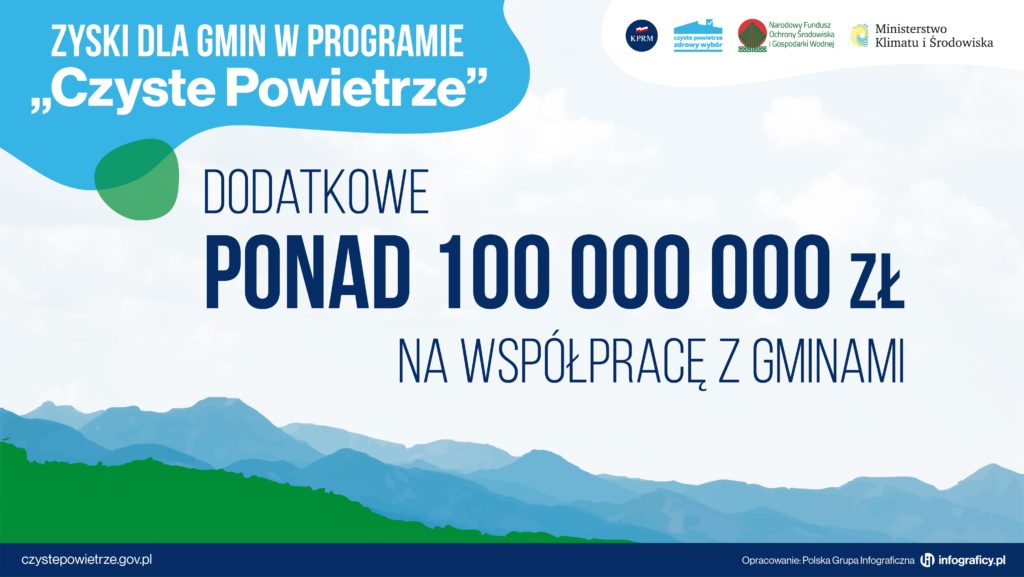
An additional 100 million for cooperation with municipalities!

The Prime Minister of the Republic of Poland, Mateusz Morawiecki, announced a package of incentives in the amount of PLN 100 million for municipalities that actively participate in the implementation of the “Clean Air” Program.

All communes expressed willingness to cooperate!

All municipalities in Małopolska have declared their willingness to cooperate with the Provincial Fund for Environmental Protection and Water Management in Krakow on running service points for the Clean Air Programme. This is a significant facilitation for residents who want to replace their furnace or carry out thermal modernisation.

E.4. Promotion of the project implementation

Eco-managers in communes prepared:

  • 17 press articles,
  • 188 articles and posts on the Internet and social media,
  • Other media were used 13 times
  • and took part in media information related to the project:

37 radio or TV broadcasts.

Today the Voivodship Administrative Court rejected the complaints of the municipalities of Rzepiennik Strzyżewski and Oświęcim against the “Air Quality Plan” adopted by the Sejmik of the Małopolska Region. This means that the comprehensive project of measures to improve air quality in our region, in force since 27 October 2020, is valid and will not be discontinued.

I am very glad that the pleas of mayors of two communes were rejected by the WSA. The complaints of the communes stemmed from their disagreement with some of the duties imposed on the local governments by the Air Quality Plan. The Voivodship Administrative Court confirmed the validity of the Programme, which for us – all inhabitants of Małopolska – is a hope for better, healthier life. I would like to remind you that over 40,000 people die in Poland every year due to air pollution. Smog is also the cause of many troublesome illnesses, such as heart and respiratory problems, or childhood developmental defects.

– Deputy Marshal of Małopolska Tomasz Urynowicz comments on the VAC verdict.

Adopted in September 2020, the Air Quality Plan will help accelerate anti-smog measures in all municipalities by putting the tasks of local authorities in order. It also introduces a number of regulations beneficial to residents – from the creation in each Małopolska municipality of an eco-manager position and a service point for the Clean Air grant programme, to support for people affected by so-called energy poverty. The recommendations described therein – such as the ban on public funding of coal-fired cookers from the beginning of this year or the elimination of classless heating devices by the end of 2022 – are firmly in line with the government’s strategic programme “Energy Policy of Poland until 2040”.

The Małopolska POP was developed on the basis of the Environmental Protection Act, amended in 2019, as well as the Ordinance of the Minister of the Environment on air quality programmes and short-term action plans from the same year. The latter document is a direct result of the 2018 judgment of the Court of Justice of the European Union, which was issued due to years of exceedances of air quality standards in Poland, including in particular the permissible level of PM10 dust. “The Air Quality Plan for Małopolska” was subject to a two-stage public consultation.

The municipalities of Rzepiennik Strzyżewski and Oświęcim have challenged certain obligations imposed on them by AQP as not provided for in the Environmental Protection Law. This includes quick inspections after residents report burning waste or entering into an agreement with the Provincial Environmental Protection Fund on running service points for the Czyste Powietrze subsidy program.

However, the law obliges the Board of the Małopolska Region, as the administrative body developing the local Air Quality Plan, to identify the corrective measures and the bodies and entities responsible for their implementation.

The most important measure to improve air quality in Małopolska is the replacement of outdated cookers and heating equipment. This process should take place with maximum use of government subsidy programmes such as Clean Air and Stop Smog. Also, the Board of the Małopolska Region has earmarked EUR 420 million within the Regional Operational Program, in the 2014-2020 financial perspective, for measures related to the implementation of the Air Quality Plan, including EUR 96 million for thermal modernisation of public facilities and EUR 100 million for boiler replacement.

Each of the 182 municipalities in the Małopolska voivodeship had the opportunity to apply for funds for environmental protection investments available under ROP 2014-2020. This year, municipalities can draw funds for the implementation of tasks resulting from AQP from the additional PLN 100 million that the government allocated for the implementation of the Clean Air Programme – emphasises Deputy Marshal Tomasz Urynowicz. – We are also familiar with the problem of staff shortages in municipalities. That is why within the EU LIFE Integrated Project “Implementation of the Air Quality Plan for the Małopolska Region” in 62 communes that are partners of the Project the positions of eco-consultants were created, in 60% financed from the European funds. Eco-managers are also employed in the municipalities of Rzepiennik Strzyżewski and Oświęcim

he adds.

The Minister of Climate and Environment, as Operator of the Environment, Energy and Climate Change Program, invites to submit project concepts for the “Construction of a pellet plant for the production of fuel from agricultural and forest biomass”, funded by the European Economic Area Financial Mechanism 2014-2021.

Purpose of the competition:

The main objective of the call for proposals for co-financing projects under the program area “Renewable energy, energy efficiency, energy security” is to improve energy security and reduce energy poverty in municipalities.

This aim is to be achieved by using local biomass to produce fuel for energy-poor households and replacing the social assistance offered to these households in the form of coal fuel with pellet fuel derived from locally available agricultural and forestry biomass.

Priority will be given to pilot and innovative projects, implemented in municipalities with a high energy poverty rate and with a high local energy resource potential in the form of agricultural and forestry biomass, enabling a continuous fuel supply.

The implementation of the projects will contribute to reducing CO2 emissions as much as possible while achieving the highest possible energy and cost efficiency ratio.

The condition for the implementation of the project will be:

  • replacement of individual heat sources of inhabitants consuming pellet fuel with sources adapted for its combustion and certified for at least emission class 5 – action implemented outside the project;
  • distributing the pelletized fuel produced free of charge to energy-poor households.

Type of projects:

Eligible for funding are projects involving the launch of a pellet production, including:

  • purchase of an installation for the production of fuel in the form of pellets produced from local agricultural and forestry biomass;
  • purchase of equipment necessary for the pre-treatment/preparation of agricultural and forestry biomass for pellet production;
  • construction of storage and drying facilities for raw materials for pellet production;
  • construction of pellet storage facilities;
  • construction of premises for roofing installations and securing production.

Eligible costs for the implementation of the project may include costs comprising necessary expenditure to launch the production of pellets together with the necessary infrastructure, excluding the construction or modernization of energy sources feeding the pelletising machine.

It is recommended that the scope of the project includes educational and training activities on the subject related to air and climate protection, in particular pollution from individual heat sources, as complementary activities for investment activities.

In addition, the scope of the projects may also include the purchase and installation of lanterns to illuminate the storage and production of pellets powered by renewable energy.

Under the call for proposals projects submitted in one of two variants may be financed. The choice of the variant depends on the applicant and will be made at the stage of submitting the project concept in the Co-financing Application Generator (…).

Deadline and method of submitting project concepts / applications for funding:

Closing date for receipt of design concepts from applicants –31.03.2021 15:00.

Project concepts (within stage I) and grant applications (stage II) are drawn up exclusively with the use of the Grant Application Generator (GWD). Detailed rules on submitting project concepts and applications for co-financing via the GWD are defined in the Rules of Competition.

Project concepts and grant applications with attachments should be submitted to the National Fund for Environmental Protection and Water Management in electronic form via the GWD available on the National Fund for Environmental Protection and Water Management’s website.

More information?

For more information about the competition, please visit the websites of the Ministry of the Environment and the National Fund for Environmental Protection and Water Management:

Polish Prime Minister Mateusz Morawiecki has announced an incentive package of PLN 100 million for municipalities that actively participate in the implementation of the Clean Air Program.

Each commune which has signed, or will conclude by the end of May 2021, an agreement on running a service point for the “Clean Air” Program with the relevant Regional Environmental Protection and Water Management Fund (WFOŚGW) will receive grant support for this purpose in the total amount of up to PLN 30 thousand. What is important, in order to receive the grant, the communes that have not yet entered into an agreement with the WFOŚiGW must notify the relevant Regional Environmental Fund in writing of their intention to conclude the above-mentioned agreement by the end of February this year.

 The Clean Air Program is the main source of subsidies for the residents of Małopolska to replace cookers and thermo-modernise their homes. Eco-managers employed in over 60 communes are helping to use this source; regulations recently adopted in Małopolska also impose an obligation to create a Clean Air Program service point in each commune. I appeal to local self-governments to take advantage of the opportunity to obtain the funds announced by the Prime Minister

– explains Deputy Marshal Tomasz Urynowicz.

In September last year the Sejmik of the Małopolska Region adopted a new Air Quality Plan for the Małopolska Region (Resolution No. XXV/373/20). It obliges all municipalities in Małopolska to sign an agreement on starting a service point for the “Clean Air” Program.

Who are the measures aimed at?

The mentioned 100 million PLN is an additional amount, directed not to private beneficiaries of the program, but to local governments. The funds may be spent, for example, on organising meetings with the inhabitants of particular communes, during which they will be able to learn how to participate in the program and why it is important.

According to the anti-smog resolution for Małopolska, by the end of 2022 all out-of-class furnaces must be replaced, and by the end of 2026 those of emission class 3 or 4. Research by Polish scientists shows that air pollution is responsible for over 40 000 deaths in the country. Long-term smog breathing also exacerbates symptoms and increases mortality in people infected with COVID-19.

Incentives for municipalities!

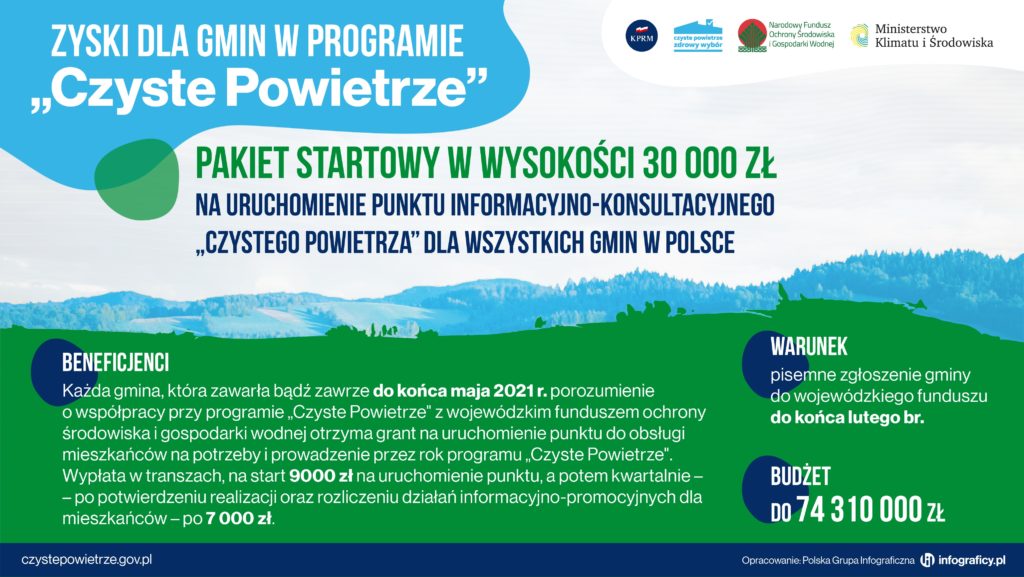
Starting package in the amount of PLN 30 000

For launching a “Clean Air” information and consultation point for all municipalities in Poland.

Beneficiaries

Each commune which has signed or will conclude by the end of May 2021 an agreement on cooperation in the “Clean Air” program with the Provincial Fund for Environmental Protection and Water Management will receive a grant for launching a point of residence service for the purposes and carrying out the “Clean Air” program for a year. Payment in tranches, at the start PLN 9000 to launch the point, and then quarterly – after confirmation of implementation and settlement of information and promotional activities for residents – PLN 7000 each.

Terms and conditions

Written notification of the municipality to the provincial fund by the end of February this year.

Budget

Up to PLN 74 310 000

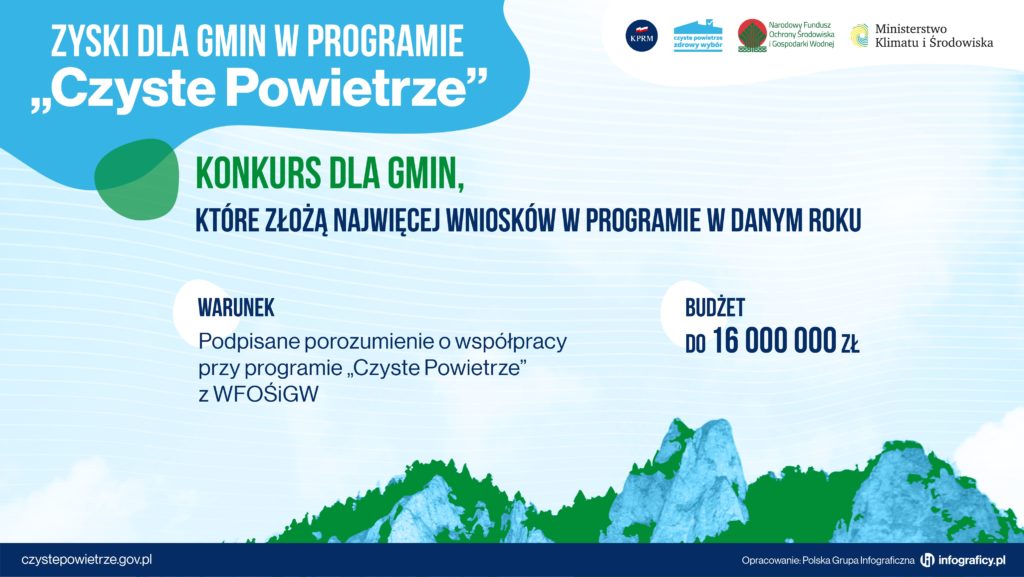
Competition for municipalities

Which will submit the most applications in the program in a given year.

Condition

Signed agreement on cooperation in the Clean Air Program with WFOŚiGW

Budget

Up to 16 000 000 PLN

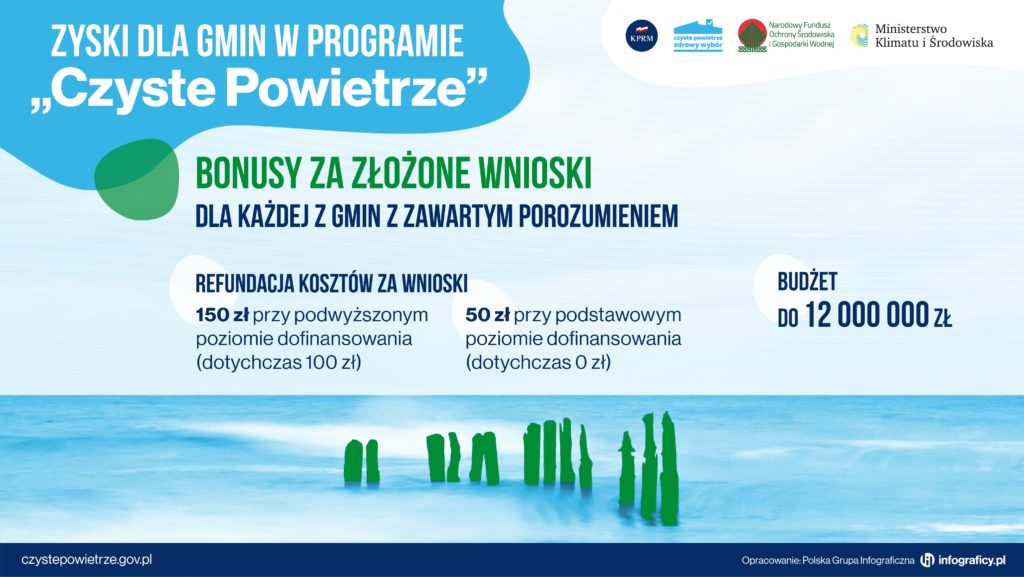
Bonuses for submitted applications

For each municipality with an agreement.

Refund of costs for applications

  • PLN 150 with increased level of co-financing (until now: PLN 100)
  • PLN 50 with basic level of co-financing (until now: PLN 0)

Budget

Up to 12 000 000 PLN

Photo gallery:

Main events

  • The implementation of the LIFE EKOMAŁOPOLSKA project “Implementation of the Regional Action Plan for Climate and Energy” has started. The project is carried out from 1 January 2021 to 31 December 2030, together with 26 partners.
  • Continuation of radio campaigns conducted on RMF FM, RMF MAXXX – Kraków and Nowy Sącz, in which ecological issues were raised.
  • Due to the COVID-19 pandemic, the implementation of the LIFE project’s eco-consultancy activities has been limited. It was difficult to carry out tasks on a full-time basis, due to remote working and restrictions in receiving clients and organising events.
  • Eco-managers distributed in total almost 42 000 informational and educational materials and gave over 8000 advices to the Małopolska residents.

C.1. Eco-managers

Advice and help for residents

In January, Eco-managers employed under the LIFE program provided advisory assistance to the residents of Małopolska in the following dimensions:

  • 2113 persons admitted in the office
  • 4495 by phone
  • 1181 in writing or by e-mail
  • 316 during visits

490 inspections were carried out at residents regarding waste incineration. In 11 cases, violations were found.

Surveys from residents and applications for funding

Eco-managers were involved in collecting surveys from residents and processing applications for funding.

In January 2020:

  • 255 questionnaires were collected from residents interested in receiving funding,
  • 154 applications for co-financing from residents or entities were processed,
  • 160 agreements with residents or entities for co-financing were signed and 140 such agreements were settled.

The eco-managers entered or updated data on 9222 buildings in the heating database.

C.2. Competence Centre

List of low-emission heating appliances

The list of low-emission solid fuel heating appliances that meet Ecodesign requirements, available at www.powietrze.malopolska.pl, includes a total of 354 boilers and space heaters.

Application “Eco-intervention”

In January, 1610 applications were received. The application is available at https://ekomalopolska.pl/app/ekointerwencja/index.html, the website says.

It can be specified:

  • 1142 reports of air pollution,
  • 168 illegal waste disposal,
  • 31 sewage and waste discharges.

The hotline operated by the Competence Centre of UMWM responded to over 300 telephone calls.

Online training – Meeting with the expert

The Polish National Energy Conservation Agency as part of online training courses entitled in January, “Meeting with an expert” organized three events in which eco-managers took part:

  •    13.01. – Meeting with KAPE expert – Energy efficiency in SME
  •    20.01. – Meeting with KAPE expert – Small-scale retention
  •    27.01. – Meeting with KAPE expert – Conditions for development of civic energy in Poland.

E1. Regional media campaign for clean air

Radio campaigns

In January, radio campaigns were continued on RMF FM, RMF MAXXX – Kraków and Nowy Sącz, in which the subject of ecology was discussed.

E.2. Local information and education activities in the field of air protection

Educational materials on air protection

Eco-managers in the municipalities:

  • prepared 31 842 leaflets and brochures and 331 posters,
  • distributed 27 859 leaflets and brochures and 683 posters,
  • prepared 14 162 and distributed 13 793 other educational and promotional materials (promotional materials, leaflets connected with the Clean Air Program).

Meetings and events

Eco-managers organised meetings and events:

  • 3 competitions for children/young people, in which 67 people participated,
  • 4 meetings in school and kindergartens, attended by 104 people
  • 7 meetings with residents, attended by 376 people,
  • 26 meetings with local leaders, attended by 93 people in total.
  • 4 other events on air protection, attended by 19 900 people.

E. 3. Creating networks for sharing experience with other projects.

  • The implementation of the LIFE EKOMAŁOPOLSKA project “Implementation of the Regional Action Plan for Climate and Energy” started on 1 January 2021. The project will last until 31 December 2030 and will be implemented in cooperation with 26 partners, including the Ministry of Development, the Silesian Voivodeship and the AGH University of Science and Technology in Krakow as well as 18 counties in the Małopolska region. One of the most important goals of the project is to prepare scenarios for reduction of greenhouse gas emissions for Małopolska until 2030 and 2050.
  • On the 25th of January the first technical meeting with partners of the LIFE EKOMALOPOLSKA project took place. Financial and content-related issues were discussed. Issues and questions raised by the partners were also discussed.

E.4. Promotion of project implementation

Eco-managers in the municipalities prepared:

  • 14 articles in the press,
  • 200 articles and posts on the Internet and social media,
  • 15 times used other media

and took part in media information related to the project:

  • 16 radio or TV broadcasts.