Malopolska Region is breathing better, but challenges still remain. Summary of the fight for clean air in 2025.
2025 was another intensive stage in the fight for cleaner air for the Malopolska Region. Local governments, residents and public institutions consistently implemented measures aimed at reducing low emissions, modernising buildings and developing renewable energy sources. Although the data show clear progress, especially compared to the situation a decade ago, the past year also brought warning signals regarding air quality.
More than 14 thousand “smokers” disappeared from the Malopolska Region
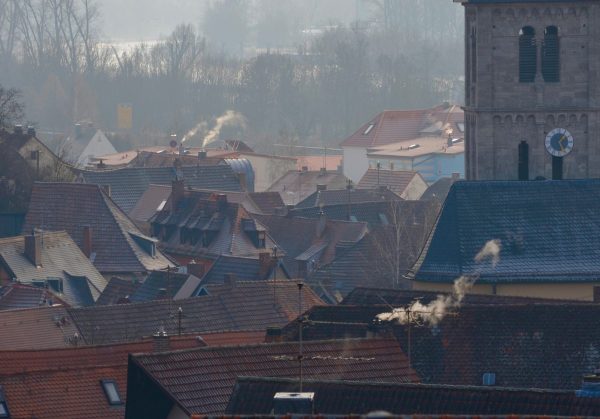
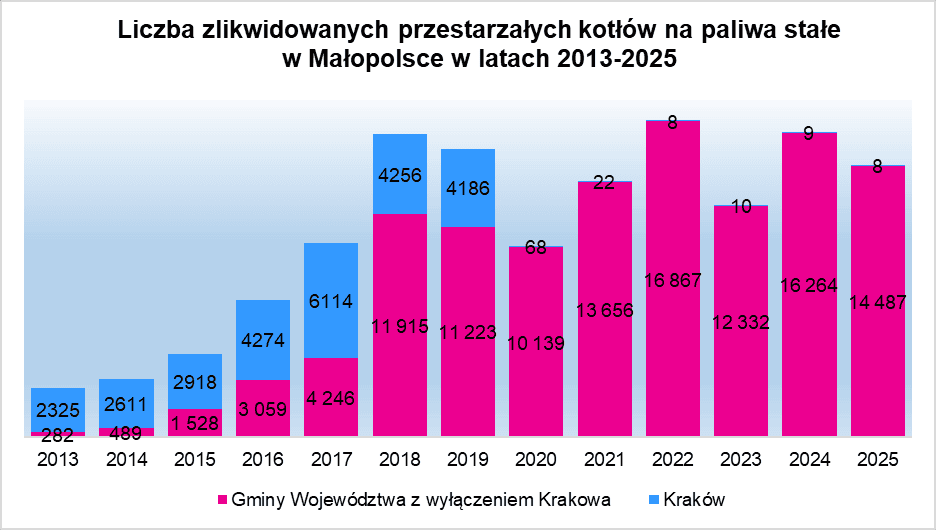
The most important element of the air quality improvement programme remains the replacement of outdated heating sources. In 2025, inefficient solid fuel boilers were removed from as many as 14,495 buildings and premises in the Malopolska Region. Residents most often opted for gas installations and biomass boilers.
This marks another year of the region’s systematic energy transition. Just over a decade ago, old coal-fired furnaces were one of the main sources of winter smog. Today, the scale of replacements shows that the Anti-smog resolution and financial support programmes are genuinely changing the way homes are heated across the region.
Fewer thermal retrofits than the year before
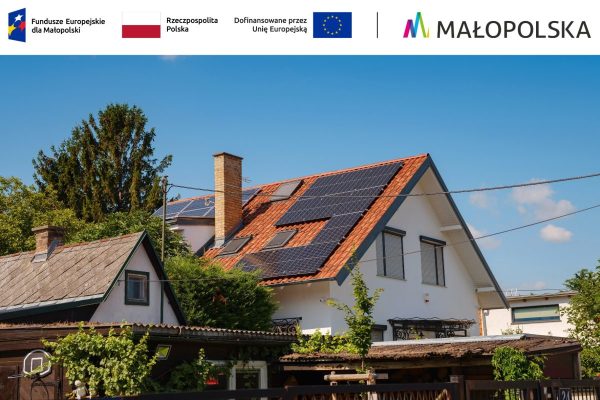
In 2025, residents of the Malopolska Region completed 4,760 thermal retrofits of residential buildings and carried out 12,255 renewable energy source investments. Although the scale of these activities remained significant, it was slightly lower than in the previous year, when 6,359 thermal retrofits were completed and 13,647 RES installations were launched. Nevertheless, renewable energy sources and improvements in the energy efficiency of buildings continue to play a key role in improving air quality and supporting the region’s energy transition.
Inspections and fines. Municipalities continue the fight against waste burning
In 2025, all municipalities in the Malopolska Region carried out inspections related to compliance with the Anti-smog resolution and the ban on waste burning. A total of 25,737 inspections were conducted.
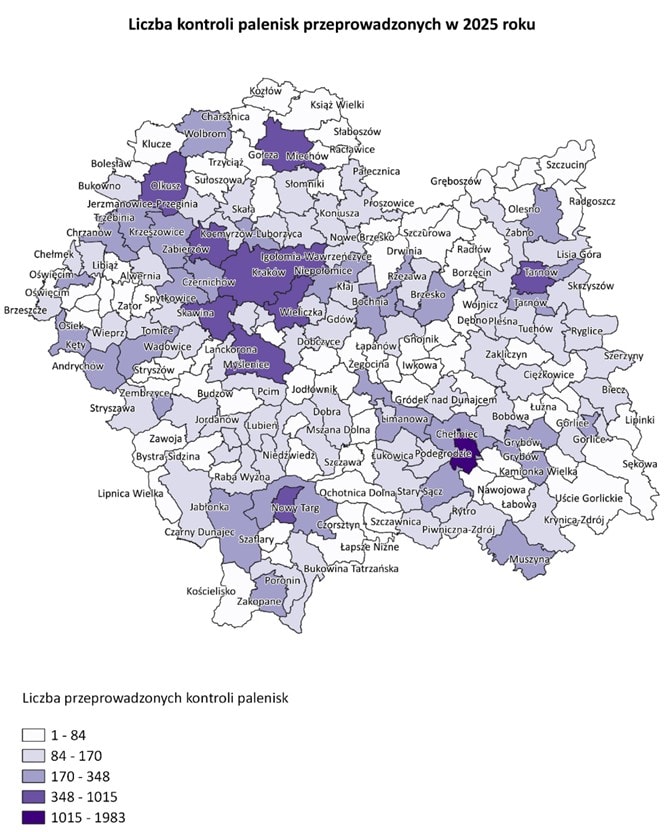
During the inspections, the following were identified:
- 3,175 cases of violations of the Anti-smog resolution,
- 718 cases of waste burning.
A total of 528 fines were imposed on residents, and 73 cases were referred to court. The data show that despite growing environmental awareness, the problem of illegal waste burning still persists.
Ecomenagers becoming increasingly important support for residents
Ecomenagers play a major role in the energy transition process. They help residents choose sources of funding, explain regulations and support the process of replacing heating systems.
At the end of 2025, the following were operating in the Malopolska Region:
- 277 Ecomenagers in 182 municipalities,
- 26 climate Ecomenagers at county level.
For comparison, in 2023 there were 249 such specialists. The increase in their number was made possible thanks to support from the European Funds for Małopolska 2021–2027.
Air quality worse than the year before, but the long-term trend remains positive
According to the Annual Air Quality Assessment prepared by the Chief Inspectorate of Environmental Protection, 2025 brought a deterioration in air quality compared to 2024, particularly in terms of the number of days with exceedances of PM10 standards.
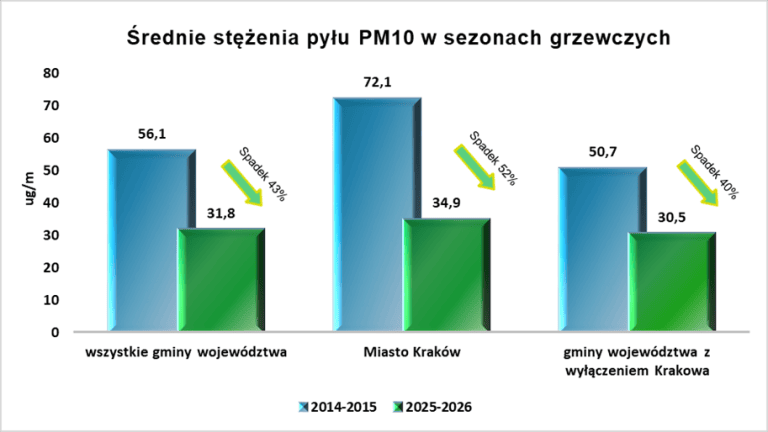
However, the broader perspective shows the enormous improvement achieved over the past decade. During the 2025/2026 heating season, the average PM concentration in the Malopolska Region was 43% lower than in the winter of 2014/2015 — before the Anti-smog resolution came into force.
The greatest progress was recorded in Krakow, where PM10 concentrations fell by as much as 52%. In the rest of the region, the reduction amounted to 40%.
The Malopolska Region is changing before our eyes
The 2025 data confirm that the Malopolska Region is consistently implementing actions aimed at improving air quality and reducing low emissions. The changes are becoming increasingly visible, especially during the heating season, when just a few years ago smog was one of the region’s biggest challenges.
At the same time, measurement results show that the fight for clean air is not over. Pollution levels are influenced not only by investments and the pace of replacing heating sources, but also by weather conditions and the situation on the energy market.
Despite these challenges, the direction of change remains clear — thanks to systematic investments, support from local governments and the engagement of residents, the Malopolska Region is steadily moving towards becoming a region with cleaner and healthier air.